
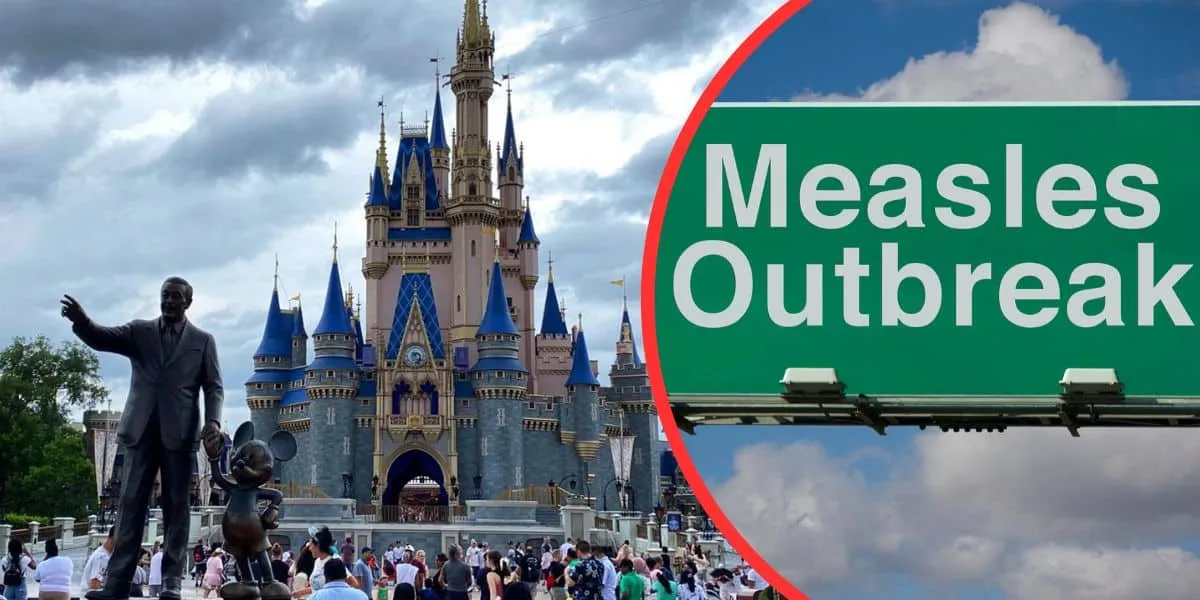
You may have heard about a measles outbreak connected to Disneyland and wondered whether it really happened or if it’s just a rumor.
Because of how widely the story was covered, it continues to come up in discussions about public health and travel.
So, was there actually a measles outbreak at Disneyland?
Was there a measles outbreak at Disneyland?
Yes — there was a confirmed measles outbreak linked to Disneyland in late 2014 and early 2015.
Health officials traced the outbreak back to visitors at Disneyland Park, where the virus spread among guests.
What happened during the outbreak ?
The outbreak began in December 2014 and quickly spread beyond California.
Key facts:
- More than 100 cases were reported
- Cases appeared in several U.S. states
- Some cases were linked to international travel
Health authorities identified Disneyland as a central exposure location during the early phase of the outbreak.
Why it spread so quickly ?
Measles is a highly contagious viral disease, which makes it easy to spread in crowded environments like theme parks.
Factors that contributed included:
- Large numbers of visitors
- Close contact in public spaces
- Unvaccinated individuals
Why it spread so quickly ?
Measles is a highly contagious viral disease, which makes it easy to spread in crowded environments like theme parks.
Factors that contributed included:
- Large numbers of visitors
- Close contact in public spaces
- Unvaccinated individuals
What Is Measles?
Measles is a highly contagious viral infection that spreads easily through respiratory droplets when an infected person breathes, coughs, or sneezes. Symptoms usually include:
-
High fever
-
Cough
-
Runny nose
-
Red, watery eyes
-
A characteristic rash that spreads across the body
It can lead to serious complications such as pneumonia, encephalitis (brain inflammation), and even death, especially in young children or people with weakened immune systems. Effective prevention is primarily through the measles, mumps, and rubella (MMR) vaccine, which provides strong protection when two doses are administered.
The 2014–2015 Disneyland Measles Outbreak
One of the most widely known outbreaks in recent U.S. history began at Disneyland Resort in Anaheim, California in December 2014, continuing into early 2015. Health authorities traced a cluster of measles cases back to people who had visited Disneyland or the adjacent Disney California Adventure Park during a specific period in December.
During this outbreak:
-
At least 131 confirmed cases occurred in California alone, with nearly 90% of those in Southern California.
-
Cases were also linked to other U.S. states, with health departments reporting infections in states such as Arizona, Colorado, Nebraska, Oregon, Utah, and Washington.
-
International spread occurred, including 159 cases in a community in Quebec, Canada, and one confirmed case in Mexico.
-
The initial index case — the first known case in the chain — was never definitively identified, though some specimens matched strains circulating overseas at the time.
-
Most individuals who became sick were unvaccinated or had unknown vaccination status, causing public health officials to point strongly to undervaccination as a key factor in the outbreak’s growth.
-
The outbreak ultimately subsided by mid-April 2015, after surveillance showed no new linked cases for two full incubation cycles of the virus.
-
There were no confirmed deaths directly tied to this outbreak, though several cases were hospitalized due to complications.
This episode reignited national discussion about vaccine coverage and public health, because measles was previously considered eliminated in the U.S. due to high vaccination rates before the resurgence. The outbreak also helped spur changes to California vaccination laws, including reducing non-medical exemptions for required vaccines to attend school and fostering stronger emphasis on immunization.
Why It Happened ?
Public health experts noted several contributing factors to the severity of the outbreak:
-
Clusters of low vaccination in certain communities reduced herd immunity, meaning the virus could spread more easily among those without protective immunity.
-
Disneyland and similar theme parks attract large crowds from around the world, increasing the chance that someone infected abroad could introduce the virus and that it could spread among visitors.
-
Measles is extremely contagious — a single infected person can spread the virus to many others in crowded spaces.
Studies following the outbreak concluded that vaccination refusal in some groups played a major role in enabling the spread of measles during this event.
Recent Measles Exposure in 2026
More than a decade after the 2014–2015 outbreak, another measles case tied to a Disneyland visit was reported in January 2026. Health officials in Orange County, California, confirmed that an international traveler infected with measles visited Disneyland Resort and associated areas on January 28, 2026. Public health authorities later issued warnings about possible exposure during specific times and locations, including:
-
Goofy’s Kitchen at the Disneyland Hotel
-
Disneyland Park
-
Disney California Adventure Park
Because measles can incubate for about 7 to 21 days, people present in these areas during the exposure window were urged to check their immunity status or consult healthcare providers if needed. Disneyland officials said they were cooperating with local health departments to support guest and cast member well-being and follow recommended precautions.
This recent case does not yet appear to be a large outbreak on the scale of 2014–2015, but rather a situation where exposure to a contagious visitor raised public health concerns and heightened awareness around vaccination and monitoring.
Public Health Lessons from Disneyland Outbreaks
The history of measles tied to Disneyland highlights several important public health principles:
1. Vaccination Matters
The best way to prevent measles infection and outbreaks is through high vaccination coverage, especially maintaining herd immunity by ensuring communities have high rates of the two recommended MMR shots by school age.
2. International Travel Can Reintroduce Disease
Measles still circulates widely in many countries. Visitors who are not fully immunized can unintentionally bring the virus into places where immunity is lower, leading to outbreaks.
3. Crowded Public Spaces Increase Risk
Highly visited destinations like theme parks, airports, and concerts can amplify transmission because of close contact among diverse groups of people.
4. Monitoring and Rapid Response Are Key
Public health departments track cases, notify exposed individuals, and promote vaccination to limit spread once a case is identified.
-
Yes, there was a major measles outbreak linked to Disneyland beginning in December 2014, with over 130 cases in California and additional cases in multiple U.S. states as well as Canada and Mexico. This outbreak officially ended in Spring 2015.
-
The outbreak highlighted the dangers of low vaccination rates and helped revive national vaccine debates and policy changes.
-
In early 2026, a new measles exposure at Disneyland was reported linked to an infected international traveler, prompting warnings and guidance from health officials.
-
Measles remains preventable with vaccination, and monitoring continues wherever potential exposures are identified.
What Is the Genotype of the Measles Virus in the Disneyland Outbreak?
When health officials investigate measles outbreaks, they look not just at who is infected but which strain (genotype) of the virus is involved. This helps track how the infection spread and where it might have come from.
Genotype of the 2014–2015 Disneyland Measles Outbreak
The large measles outbreak that was linked to Disneyland Resort in California during late 2014 and early 2015 was caused by the measles virus genotype B3. This is the same genetic strain detected in specimens from many of the people infected during that outbreak.
Public health laboratories analyzed samples from confirmed measles patients linked to the outbreak and found that all the genotyped cases were measles virus genotype B3. This genotype was also identical to the strain responsible for a major measles epidemic in the Philippines in 2014, which suggests the virus was introduced into California by an infected traveler from overseas and then spread among unvaccinated or undervaccinated groups. This genotype B3 virus has been identified in many countries and U.S. states around that time, making it one of the more widely circulating strains during that period.
In fact, in laboratory analyses of about 30 patient samples from that outbreak, genotype B3 was consistently identified, confirming that the outbreak was caused by a wild (naturally circulating) measles virus rather than a vaccine strain. Health agencies also noted that these B3 sequences were “identical” across cases in the outbreak, meaning they shared the same genetic signature — a key piece of evidence linking the cases together.
Why Genotyping Matters ?
Measles genotyping is a tool used globally to understand how and where the virus is spreading. Different measles genotypes correspond to distinct genetic lineages of the virus. Although measles is one disease regardless of genotype, identifying the genotype helps epidemiologists:
-
Trace the origin of an outbreak
-
Link cases that are part of the same transmission event
-
Monitor global patterns of measles spread
Genotype B3 was common in several parts of the world during the mid-2010s, especially in parts of Africa and Asia. Because measles had previously been declared eliminated in the United States (meaning ongoing local transmission was stopped), cases that appeared were almost always due to importations from places where the virus was still spreading.
-
The measles virus genotype identified during the Disneyland outbreak in 2014–2015 was B3.
-
Laboratory testing showed B3 in all genotyped specimens linked to the outbreak, with genetic signatures matching viruses circulating internationally at the time.
-
This genotype is one of the global measles lineages that has spread widely in recent years.
Understanding genotypes doesn’t change how measles is treated or prevented — vaccination remains the most effective protection — but it does provide important clues about how outbreaks begin and spread.
While the outbreak was eventually contained, it continues to be cited as an example of how quickly infectious diseases can spread in crowded public settings.
FAQ
When did the Disneyland measles outbreak happen?
It began in December 2014 and continued into early 2015.
How many people were affected?
More than 100 confirmed cases were reported.
Was Disneyland officially responsible?
No, but it was identified as a key exposure location.

Abdeslam is the Founder and Editor-in-Chief of Prevnews.top, where he oversees global news coverage and editorial integrity. With over 13 years of experience in digital journalism and a background in Blogging, i specializes in translating complex global events into actionable insights. Abdeslam is committed to 100% human-verified reporting. Connect with him on [LinkedIn] or follow his latest updates on [Twitter/X].