
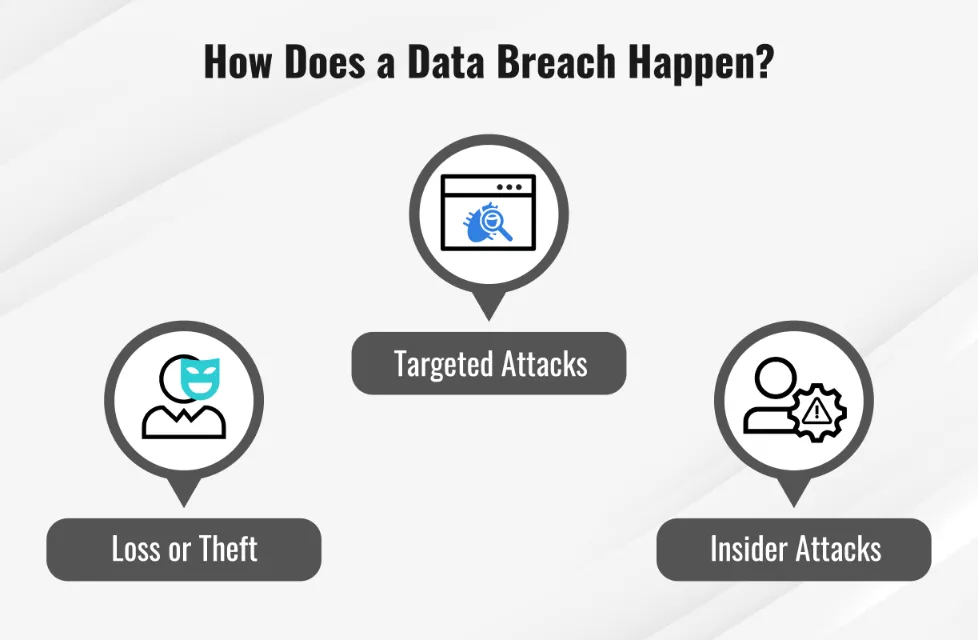
A data breach happens when private, protected, or confidential information is accessed, stolen, exposed, or leaked without permission.
In simple terms:
A data breach is when someone gets access to data they are NOT supposed to see.
That can mean hackers stealing data, employees leaking it, or even companies accidentally exposing it online.
1. What Counts as “Data”?
In a data breach, “data” usually means personal or sensitive information, such as:
Personal Information
-
Full name
-
Home address
-
Phone number
-
Email address
-
Date of birth
Financial Information
-
Credit card numbers
-
Bank account details
-
Payment history
-
Tax records
Login and Account Information
-
Usernames
-
Passwords
-
Security questions
-
Two-factor authentication details
Government and Identity Data
-
Social Security numbers
-
Passport numbers
-
Driver’s license numbers
-
National ID numbers
Health Data
-
Medical records
-
Insurance details
-
Diagnoses and treatments
Business and Corporate Data
-
Trade secrets
-
Customer lists
-
Contracts
-
Internal communications
So a breach can involve anything from a single leaked email address to millions of stolen identities.
2. How Data Breaches Actually Happen
Data breaches can happen in several ways. The most common are:
A) Hacking (Cyberattacks)
This is the classic scenario.
Hackers break into a company’s systems by:
-
Exploiting security flaws
-
Guessing passwords
-
Using malware
-
Breaking into servers
Once inside, they steal or copy data.
B) Phishing (Tricking People)
Phishing is one of the most common causes of data breaches.
A hacker sends an email or message that looks legitimate, such as:
-
“Your bank account is locked—log in here.”
-
“Your package is delayed—confirm your address.”
-
“Your password expires today—reset it now.”
If the person clicks the fake link and enters credentials, the hacker gets access.
C) Insider Leaks
Sometimes breaches happen from inside the organization.
For example:
-
An employee intentionally steals customer data
-
A worker sells private information
-
Someone downloads data before quitting
This is called an insider breach.
D) Accidental Exposure
Not all breaches are caused by hackers.
A company might:
-
Upload a file publicly by mistake
-
Misconfigure a cloud storage system
-
Leave a database unprotected
-
Send personal info to the wrong email address
Even though it’s an accident, it still counts as a breach.
E) Stolen Devices
A breach can happen if:
-
A laptop is stolen
-
A phone with sensitive info is lost
-
A USB drive containing data disappears
If the device isn’t encrypted, the data can be accessed.
3. What Happens in a Data Breach?
When a data breach occurs, several things usually happen:
1. Data is accessed
Someone gets into the system or database.
2. Data is copied, leaked, or stolen
They may download it or expose it publicly.
3. The breach is discovered
Sometimes quickly, sometimes months later.
4. The company investigates
Cybersecurity teams try to figure out:
-
What happened
-
What data was affected
-
Who was impacted
-
Whether the attacker is still inside
5. Users are notified
Many countries and states require breach notifications by law.
6. Damage begins
This can include fraud, identity theft, and reputational harm.
4. Why Data Breaches Are So Serious
A data breach can harm both individuals and companies.
For Individuals
A data breach can lead to:
Identity theft
Someone uses your personal data to:
-
Open credit cards
-
Take loans
-
File taxes in your name
Financial fraud
Stolen card details can be used for purchases.
Account takeovers
If passwords are leaked, hackers may log into:
-
Email accounts
-
Social media
-
Banking apps
-
Work systems
Blackmail or harassment
If private messages, photos, or sensitive info leaks, it can be used maliciously.
For Companies
Companies can suffer:
-
Legal penalties
-
Lawsuits
-
Loss of customer trust
-
Business disruption
-
Ransom demands
-
Massive recovery costs
5. Data Breach vs Data Leak: Are They the Same?
People often confuse these terms, but they’re slightly different:
Data Breach
-
Usually involves unauthorized access
-
Often includes hacking or theft
-
Can be intentional
Data Leak
-
Often accidental exposure
-
Example: a public cloud folder with customer info
-
Still dangerous, even without hacking
So:
A leak is a type of breach, but not all breaches are leaks.
6. Common Signs Your Data Was Breached
You may suspect a breach if you notice:
-
Password reset emails you didn’t request
-
Strange login alerts
-
New accounts opened in your name
-
Charges on your bank statement you don’t recognize
-
Spam emails or scam calls increasing suddenly
-
Your email appearing in password dump lists
7. What You Should Do After a Data Breach
If you find out your data was breached, the best steps are:
1. Change your password immediately
Especially for:
-
Email accounts
-
Banking accounts
-
Any reused passwords
2. Enable two-factor authentication (2FA)
This makes it harder for hackers to get in.
3. Monitor your bank and credit
Check:
-
Statements
-
Credit reports
-
New account activity
4. Freeze your credit (if available in your country)
This prevents new credit accounts from being opened.
5. Watch out for phishing
After a breach, scammers often target victims using the stolen info.
8. A Simple Example
Let’s say you have an online shopping account.
A data breach could expose:
-
Your email
-
Your password
-
Your address
-
Your saved credit card
A hacker could then:
-
Log in
-
Order items
-
Access other accounts if you reuse passwords
-
Sell your info online
That’s why breaches are such a big deal—even if the company says “no financial data was stolen.”
A data breach means:
✅ Someone accessed or exposed sensitive information without permission.
It can happen through hacking, phishing, insider actions, or accidents.
And it matters because it can lead to:
-
Identity theft
-
Financial fraud
-
Account takeovers
-
Privacy violations
Is data breach a crime?
Yes — a data breach can absolutely be a crime, but it depends on how it happened and who caused it.
Here’s a detailed, clear article explaining it properly:
Is a Data Breach a Crime? (Detailed Explanation)
A data breach means sensitive information was accessed, exposed, stolen, or leaked without authorization. In many cases, the act that caused the breach is illegal, and therefore a crime.
However, not every data breach is automatically a criminal act. Some breaches happen because of accidents, mistakes, or poor security rather than intentional wrongdoing.
So the real answer is:
A data breach is often caused by a crime — but the breach itself isn’t always criminal.
1. When a Data Breach IS a Crime
A data breach becomes a crime when someone intentionally gains access to data without permission or uses stolen data illegally.
Here are the most common criminal scenarios:
A) Hacking Into a System
If someone breaks into a company’s servers, email accounts, or databases, that is a crime in most countries.
This includes:
-
Exploiting security vulnerabilities
-
Breaking passwords
-
Using malware or ransomware
-
Unauthorized access to cloud storage
Even if they don’t steal anything, simply breaking in is often illegal.
B) Stealing or Selling Personal Data
If someone steals data and then:
-
sells it online
-
posts it publicly
-
uses it for fraud
-
uses it for blackmail
That’s criminal behavior.
This can involve:
-
credit card theft
-
identity theft
-
financial fraud
-
doxxing
C) Phishing and Social Engineering
Many breaches happen because attackers trick people into giving access.
For example:
-
fake login pages
-
scam emails pretending to be IT
-
“your account is locked” messages
Phishing is usually considered fraud and is illegal in most places.
D) Insider Crimes
Sometimes a breach is caused by someone inside a company, such as:
-
an employee stealing customer data
-
a worker selling information
-
someone leaking private files intentionally
This is often prosecuted as:
-
theft
-
fraud
-
breach of confidentiality
-
unlawful access
E) Ransomware Attacks
Ransomware is one of the clearest examples of a criminal breach.
A hacker:
-
breaks into a system
-
steals or encrypts data
-
demands money to restore access
This is usually prosecuted under multiple serious criminal laws.
2. When a Data Breach Is NOT Necessarily a Crime
Not all breaches involve criminals.
Some happen because of mistakes, such as:
Accidental exposure
-
a company leaves a database open online
-
a file is uploaded publicly by mistake
-
a cloud storage folder is misconfigured
Human error
-
someone sends a spreadsheet to the wrong person
-
an employee loses a laptop
-
passwords are stored insecurely
Bad security
-
outdated systems
-
weak passwords
-
no encryption
In these cases, the breach may not be a crime — but the company can still face:
-
legal consequences
-
regulatory fines
-
lawsuits
3. Who Can Be Charged with a Crime in a Data Breach?
Depending on what happened, different people can be held responsible:
The hacker
This is the most common criminal.
The insider
Employees or contractors who leak data intentionally.
Third-party vendors
If a contractor steals data or breaks the law, they can be prosecuted too.
The company?
Usually, a company is not criminally charged just for being hacked.
But a company may face criminal penalties if it:
-
knowingly lied about the breach
-
destroyed evidence
-
violated major privacy laws intentionally
-
covered it up
4. What Laws Make Data Breaches a Crime?
Most countries have laws that criminalize:
-
unauthorized access to computer systems
-
theft of digital information
-
identity fraud
-
wire fraud
-
extortion (ransom demands)
-
privacy violations
The exact name of the law depends on the country, but the principle is the same:
Accessing or stealing data you don’t have permission to access is illegal.
5. Can Someone Go to Jail for a Data Breach?
Yes.
If a person causes a breach through hacking, fraud, identity theft, or extortion, they can face:
-
jail or prison time
-
heavy fines
-
criminal records
-
civil lawsuits on top of criminal charges
Penalties are often more severe if the breach involved:
-
medical records
-
government data
-
children’s data
-
large numbers of victims
-
financial fraud
6. What About the Victims? Are They in Trouble?
If your data is stolen in a breach, you are not responsible for the breach.
However, victims can still suffer consequences such as:
-
identity theft
-
financial loss
-
account takeovers
That’s why people are encouraged to change passwords and monitor accounts after breaches.
7. A Simple Example
Crime scenario
A hacker breaks into a company database and steals customer credit cards.
That is:
✅ unauthorized access
✅ theft
✅ fraud
= a crime.
Non-crime scenario
A company employee accidentally uploads customer data publicly.
That might not be criminal, but the company may still be:
-
sued
-
fined
-
investigated
Final Summary
Yes, a data breach is often linked to crime.
But it depends on the cause:
✅ If it involves hacking, theft, phishing, selling data, or extortion → crime
⚠️ If it’s accidental exposure or negligence → usually not a crime, but still legally serious

Abdeslam is the Founder and Editor-in-Chief of Prevnews.top, where he oversees global news coverage and editorial integrity. With over 13 years of experience in digital journalism and a background in Blogging, i specializes in translating complex global events into actionable insights. Abdeslam is committed to 100% human-verified reporting. Connect with him on [LinkedIn] or follow his latest updates on [Twitter/X].