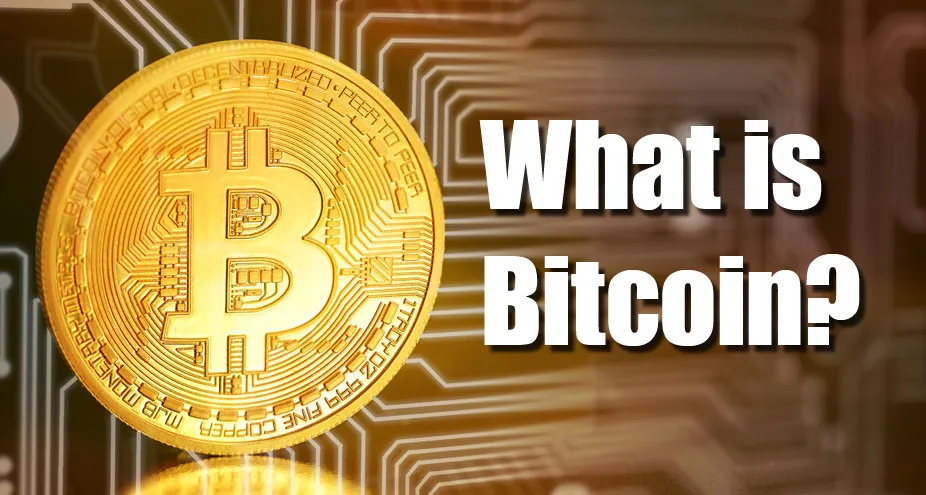
Bitcoin is a type of digital money that was created to work without a bank, government, or central company controlling it. It is the world’s first successful cryptocurrency and remains the most famous and widely used.
In the simplest terms:
Bitcoin is an online currency that people can send directly to each other without needing a middleman like a bank.
But Bitcoin is also much more than just “digital cash.” It’s a whole system made up of software, cryptography, and a global network of computers working together.
1. What Is Bitcoin?
Bitcoin (BTC) is:
-
A digital currency
-
A payment system
-
A decentralized network
-
A public ledger (blockchain)
Bitcoin exists only digitally. There are no physical Bitcoin coins printed by a government.
Instead, Bitcoin is recorded on a shared database called the Bitcoin blockchain.
2. Why Was Bitcoin Created?
Bitcoin was invented in 2008 by an unknown person (or group) using the name Satoshi Nakamoto.
The idea came during the global financial crisis, when many people lost trust in banks and governments.
Bitcoin was designed to solve major problems such as:
A) Needing banks to send money
Traditional money transfers rely on:
-
banks
-
payment processors
-
credit card companies
Bitcoin removes the need for those middlemen.
B) Inflation and money printing
Governments can print more money, which can reduce the value of a currency over time.
Bitcoin has a fixed supply (explained later).
C) Censorship
Banks can freeze accounts or block transactions.
Bitcoin was designed so that no single authority can stop a transaction if it follows the rules.
3. What Makes Bitcoin Different from Normal Money?
Here are the biggest differences:
Bitcoin is decentralized
No one owns it.
No government controls it.
No single company can shut it down.
Bitcoin is limited
Only 21 million BTC will ever exist.
Bitcoin is transparent
Every transaction is recorded on a public blockchain.
Bitcoin is borderless
It can be sent anywhere in the world, 24/7.
4. What Is the Bitcoin Blockchain?
Bitcoin runs on a technology called blockchain.
The blockchain is a public record of all Bitcoin transactions, stored across thousands of computers worldwide.
Think of it like:
A giant public accounting book that anyone can view, but no one can secretly change.
The blockchain stores:
-
who sent Bitcoin
-
who received Bitcoin
-
how much was sent
-
when it happened
But it does not store real names — it stores wallet addresses.
5. What Is a Bitcoin Wallet?
A Bitcoin wallet is not like a normal wallet that holds coins.
Instead, it holds something more important:
Your private keys
A wallet is basically a tool that:
-
stores your private key safely
-
lets you sign transactions
-
allows you to send and receive BTC
Public Key vs Private Key (Super Simple)
Public address
-
Like your email address
-
You can share it with anyone
-
People use it to send you Bitcoin
Private key
-
Like your email password
-
Must stay secret
-
Used to approve and send Bitcoin
If someone steals your private key, they can steal your Bitcoin.
6. How Does a Bitcoin Transaction Work?
Here’s the simple process:
Step 1: You create a transaction
Example:
-
You want to send 0.01 BTC to someone.
Step 2: Your wallet signs it
Your wallet uses your private key to prove:
-
you are the owner
-
you are allowed to spend the BTC
Step 3: The transaction is broadcast
It gets sent to the Bitcoin network.
Step 4: The network verifies it
Nodes check:
-
Is the signature valid?
-
Does the sender have enough BTC?
-
Is it a real transaction?
Step 5: Miners add it to a block
Miners collect transactions and bundle them into a new block.
Step 6: The transaction becomes confirmed
Once the block is added to the blockchain, the transaction is confirmed.
More blocks added afterward make it even more secure.
7. What Are Bitcoin Miners and Why Do They Exist?
Bitcoin miners are computers that:
-
validate transactions
-
secure the network
-
add new blocks to the blockchain
Mining is not about “digging coins.”
It’s about using computing power to solve a puzzle called:
Proof of Work
8. What Is Proof of Work?
Proof of Work is Bitcoin’s security system.
Miners compete to solve a difficult math problem.
The first miner to solve it:
-
earns the right to add the next block
-
receives a reward in BTC
This reward includes:
-
newly created bitcoin (block reward)
-
transaction fees
Why Proof of Work Matters
It makes Bitcoin extremely hard to cheat.
To attack Bitcoin, someone would need to control over 50% of the network’s mining power — which would cost billions and be very difficult.
9. How New Bitcoins Are Created
Bitcoin is created through mining.
Every time a miner successfully adds a block, they get rewarded.
This is how new BTC enters circulation.
But there’s a twist:
Bitcoin’s reward gets cut in half every 4 years
This is called:
The Bitcoin Halving
It reduces new supply over time and helps keep Bitcoin scarce.
10. Why Bitcoin Has a 21 Million Supply Limit
Bitcoin was designed to be scarce, similar to gold.
The software rules say:
-
the total supply can never exceed 21 million BTC
This is one reason people call Bitcoin:
-
“digital gold”
-
a hedge against inflation
-
a store of value
11. How Bitcoin Stays Secure
Bitcoin is considered secure because of:
A) Decentralization
Thousands of computers worldwide store and verify the blockchain.
B) Cryptography
Private keys, signatures, and hashing protect transactions.
C) Proof of Work
Mining makes attacks expensive and difficult.
D) Immutability
Once a transaction is confirmed, changing it would require rewriting the blockchain.
12. What Is Bitcoin Used For?
Bitcoin is used for several purposes:
A) Payments
People can use BTC to buy goods and services, though adoption varies.
B) Investing
Many people buy Bitcoin as an asset hoping it increases in value.
C) Saving / Store of Value
Some treat it like digital gold.
D) International transfers
Bitcoin can move money across borders faster than banks.
E) Financial freedom
In some countries, Bitcoin is used when banking systems are unstable or heavily restricted.
13. Bitcoin’s Weaknesses and Criticisms
Bitcoin is not perfect.
Common criticisms include:
Price volatility
Bitcoin’s value can rise or fall quickly.
Speed
Bitcoin can be slower than card payments.
Energy use
Mining uses a lot of electricity.
Scams
Bitcoin itself isn’t a scam, but scammers often use it.
Lost wallets
If you lose your private keys, your Bitcoin is gone forever.
14. Lightning Network (Bitcoin’s Speed Upgrade)
Bitcoin’s base layer is designed for security, not speed.
To make Bitcoin faster and cheaper, developers created:
The Lightning Network
It allows:
-
instant transactions
-
very low fees
-
small payments like buying coffee
Lightning works as a “second layer” on top of Bitcoin.
Bitcoin is:
-
a decentralized digital currency
-
powered by blockchain technology
-
secured through proof of work mining
-
limited to 21 million coins
-
controlled by no government or company
-
transferable worldwide without banks
Bitcoin works by using:
-
cryptography (private keys and signatures)
-
a public blockchain ledger
-
miners validating transactions through proof of work
Is Bitcoin True Money? (A Detailed Explanation)
Bitcoin is often described as “digital money,” but the question “Is Bitcoin true money?” depends on what you mean by money.
In economics, money isn’t defined by whether it’s printed by a government. Money is defined by what it does and whether people accept it.
So the real answer is:
Bitcoin can function as money, but it does not behave like traditional money in every way — at least not yet.
Let’s break it down properly.
1. What Makes Something “Money”?
Economists usually say money has three main functions:
✅ 1) Medium of Exchange
Money is used to buy goods and services.
✅ 2) Store of Value
Money holds value over time so you can save it and use it later.
✅ 3) Unit of Account
Money is the standard measure used to price things (like dollars, euros, yen).
If something does all three well, it’s considered “true money.”
2. Is Bitcoin a Medium of Exchange?
Yes — but with limits.
Bitcoin can be used to pay for:
-
goods and services online
-
international transfers
-
some physical stores in certain countries
-
person-to-person payments
Bitcoin works well as a payment tool in situations like:
-
sending money across borders
-
avoiding bank delays
-
sending large payments without a middleman
But here’s the problem:
Bitcoin is not widely accepted everywhere like dollars or euros.
Also, Bitcoin’s base layer can be:
-
slower than card payments
-
more expensive when the network is busy
That’s why many users rely on:
-
payment apps
-
exchanges
-
or the Lightning Network
Verdict: Bitcoin can be a medium of exchange, but it’s not universally practical yet.
3. Is Bitcoin a Store of Value?
This is where Bitcoin is strongest.
Bitcoin has some features that make it attractive as a store of value:
A) Limited supply
Only 21 million bitcoins will ever exist.
This makes Bitcoin different from government currencies, which can be printed in unlimited quantities.
B) Hard to seize or freeze
If someone owns Bitcoin properly (with private keys), it’s difficult for others to take it.
C) Long-term growth
Historically, Bitcoin has increased massively over long time periods, despite crashes.
The big downside: volatility
Bitcoin’s price can swing dramatically in weeks or even days.
A good store of value should be stable — and Bitcoin isn’t stable yet.
Still, many people argue:
Bitcoin is volatile because it’s still early, not because it’s broken.
Verdict: Bitcoin is a store of value for many people, but it’s not stable enough to replace traditional savings for everyone.
4. Is Bitcoin a Unit of Account?
Not really (at least for now).
This is Bitcoin’s weakest “money” function.
Most people don’t think in BTC.
Example:
-
A laptop is priced as $1,200
-
Not 0.018 BTC
Even businesses that accept Bitcoin usually:
-
price goods in dollars
-
convert the BTC amount at checkout
Bitcoin is rarely used as the main measuring unit for prices.
Verdict: Bitcoin is not widely used as a unit of account.
5. Does Bitcoin Count as Money If It’s Not Government-Backed?
Yes, it can.
A lot of people assume money must be issued by a government — but historically that’s not true.
Examples:
-
gold and silver were money long before modern governments
-
cigarettes have acted as money in prisons
-
shells and beads were used as money in older societies
Money is ultimately:
A social agreement that something has value and can be exchanged.
Bitcoin is accepted by millions of people globally, so it meets that standard more than most alternatives.
6. Bitcoin vs Fiat Currency (Dollars, Euros, etc.)
Here’s how they compare:
Fiat currency is:
-
stable day-to-day
-
accepted everywhere in its country
-
backed by government laws
-
controlled by central banks
-
inflationary by design
Bitcoin is:
-
decentralized
-
global
-
limited in supply
-
not controlled by governments
-
more volatile
-
harder to censor
So the real difference isn’t whether Bitcoin is “real” money.
It’s that:
Bitcoin is a different type of money — one designed to be independent of government control.
7. Why Some People Say Bitcoin Is “Not Real Money”
Critics often argue Bitcoin isn’t true money because:
A) It’s too volatile
A currency should not change value so quickly.
B) Not widely used in daily life
Most people still pay with cards, cash, or bank apps.
C) It’s not legal tender in most places
In many countries, you can’t pay taxes in Bitcoin.
D) It’s not backed by anything
But this criticism is tricky — fiat currency also isn’t backed by gold anymore.
8. Why Some People Say Bitcoin IS Real Money
Supporters argue Bitcoin is true money because:
A) It has scarcity
It behaves more like gold than paper money.
B) It’s decentralized
No one can print more of it.
C) It works globally
It can be transferred anywhere without a bank.
D) It’s programmable and digital
It fits the modern world better than physical cash.
9. So… Is Bitcoin “True Money”?
The most accurate answer is:
✅ Bitcoin is real money in the economic sense
Because it can store value and be exchanged.
⚠️ But it’s not fully mature money in the everyday sense
Because it isn’t stable or commonly used as a unit of account.
⭐ Bitcoin is best described as:
-
a monetary network
-
a digital store of value
-
a censorship-resistant form of money
-
a new kind of global asset
Final Conclusion
Bitcoin can be true money, depending on how you define money.
-
If you define money as “what governments print,” then Bitcoin is not money.
-
If you define money as “something people use to store and transfer value,” then Bitcoin absolutely qualifies.
Right now, Bitcoin behaves more like:
Digital gold that can also be used as money.
And as adoption grows, Bitcoin may become more “true money” over time — especially if it becomes more stable and more widely used for everyday pricing.

Abdeslam is the Founder and Editor-in-Chief of Prevnews.top, where he oversees global news coverage and editorial integrity. With over 13 years of experience in digital journalism and a background in Blogging, i specializes in translating complex global events into actionable insights. Abdeslam is committed to 100% human-verified reporting. Connect with him on [LinkedIn] or follow his latest updates on [Twitter/X].